


The End of the War or the Beginning of a New Hegemony? What Was Really Negotiated at the White House Summit
August 22, 2025 Hour: 1:01 pm
🔗 Comparte este artículo
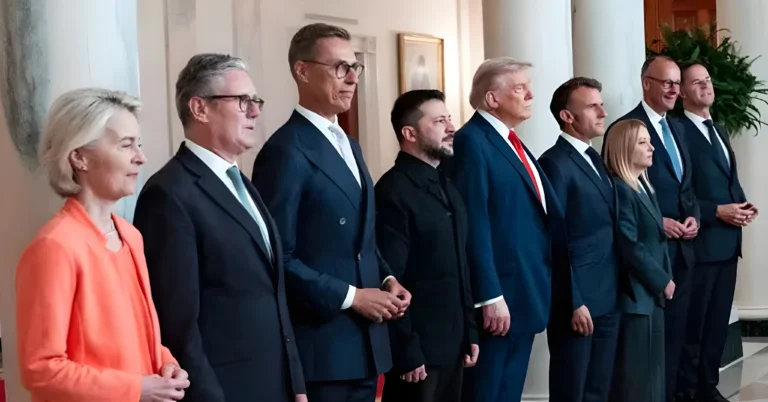
World geopolitics once again focused on a room in the White House, where U.S. President Donald Trump met with his Ukrainian counterpart, Volodymyr Zelenskyy, and key European leaders.
This meeting, held immediately after the crucial Alaska summit between Trump and Vladimir Putin, was laden with profound significance. It was not a mere diplomatic update, but the implementation of the tacit and explicit agreements reached with the Kremlin.
The outcome was not the just and lasting peace many had hoped for, but the materialization of a new hegemonic order dictated by the great powers, where the voices of directly affected actors, like Ukraine, were relegated to the background.
This analysis delves into what was really negotiated behind the scenes, the radical shift in Trump’s rhetoric from a “ceasefire” to a “peace agreement” that benefits Moscow, and the strategic implications of a potential territorial exchange that redefines the map of Eastern Europe under Russian control.
The Geopolitical Context: The Alaska Summit as a Turning Point
To understand the meeting in Washington, one must refer to the event that precipitated it: the Trump-Putin summit in Alaska.
Far from a mere protocol greeting, this meeting between two of the most geopolitically influential leaders served as the true drawing board where Ukraine’s future was sketched out.
Trump returned from Alaska with a notably altered stance. He abandoned his previous rhetoric of an immediate ceasefire and adopted the narrative framework proposed by Putin: the need for a “peace agreement.”
This semantic shift, seemingly subtle, is actually monumental. It implies a tacit recognition of Russian demands and establishes territorial concessions as the basis for any negotiation, a point NATO nations and Zelenskyy himself had sworn not to concede.
Before the Alaska summit, the Western stance was clear: no agreement would be legitimate without Ukraine’s direct participation and consent.
However, Trump returned with a de facto mandate from Putin that he immediately imposed on his allies. The summons to the White House was not to consult, but to inform and align.
The proposal for a trilateral meeting between Trump, Putin, and Zelenskyy, put forward by the American, was the first sign of this new dynamic, a script pre-written in Alaska that Ukraine was being pressured to follow.
Key Topics of the White House Conversation
The White House table gathered a who’s who of European power: German Chancellor Friederich Merz, French President Emmanuel Macron, Italian Prime Minister Giorgia Meloni, British Prime Minister Keir Starmer, Finnish President Alexander Stubb, European Commission President Ursula von der Leyen, and NATO Secretary General Mark Rutte.
The agenda, though framed as a search for peace, revolved around concrete concessions:
- Trilateral Meeting: The idea of direct dialogue between Russia, Ukraine, and the U.S., marginalizing the multilateral format that included the EU and NATO.
- Territorial Exchanges: Trump outlined, unprecedentedly for a forum with allies, the need to discuss “territorial exchanges,” based on the current contact lines on the battlefield. This would legitimize the Russian annexation of Crimea and parts of Donbas.
- Security Guarantees for Ukraine: This was the point of greatest friction. Zelenskyy argued that true security lies in a strong Ukrainian army, with access to weaponry, training, and intelligence. However, the Trump administration, personified by statements from Vice President JD Vance, made it clear that the economic and military burden would fall on Europe, freeing the U.S. from what it considers a “burden.”
- Pressure on NATO: Trump reminded allies of their commitment to raise defense spending to 5% of GDP, a measure that, while strengthening the Alliance, was achieved under the threat of withdrawing the American security umbrella, reaffirming his hegemonic power politics.
The Actors and Their Stakes
The summit was a theater where each actor played a role dictated by their national and personal interests, often in conflict.
Donald Trump: The Hegemonic Mediator
For Trump, the peace process is, above all, a stage to consolidate his power and legacy. His interest does not lie in a peace based on international justice, but in being perceived as the great mediator who managed to “stop the wars.”
It is a calculated move to aim for a Nobel Peace Prize and, most importantly, to redefine global spheres of influence to his liking.
His strategic goal is the dismantling of the liberal international order, represented by institutions like NATO (which he wants to reform in his image) and the EU, to replace it with a system of bilateral agreements where his bargaining power is absolute. His agreement with Putin is the centerpiece of this hegemonic project.
Volodymyr Zelenskyy: Between a Rock and a Hard Place
The Ukrainian president was in an untenable position. Signing a peace agreement under the terms set by Trump (and therefore, by Putin) would mean the permanent cession of sovereign territory and renouncing NATO, an act that would be perceived as a monumental betrayal by a citizenry that has sacrificed so much.
His emphasis on real security guarantees and a strong army is a desperate attempt to find an alternative to capitulation.
A ceasefire benefits him tactically to rearm, but accepting the concessions demanded by Moscow could be his political death sentence and the end of the project of a sovereign and whole Ukraine.
European Leaders: Hostages of Realpolitik
The EU representatives found themselves trapped. Their economic and security dependence on the United States is undeniable, which severely limits their ability to openly oppose Trump.
While they fervently desire an end to a war that destabilizes their continent, the price they are asked to pay, normalizing Russian aggression, making geopolitical concessions, and assuming a monumental financial burden, is bitter. Vice President Vance’s statement made Washington’s new mantra clear: “It’s your continent, it’s your security.”
Europe is forced to assume a leadership it did not seek and to choose between an unjust peace imposed by Washington and Moscow or a prolongation of the conflict with dwindling American support.
Vladimir Putin: The Great Absent Presence
Although not physically in the room, Putin’s shadow and his interests permeated everything. The White House summit was, in essence, the ratification of the terms he managed to impose in Alaska.
He succeeded in having his framework of a “peace agreement” (and not a simple ceasefire) adopted as official. He achieved having Ukrainian territorial cession openly discussed at the seat of power of his main geopolitical adversary.
And, most importantly, he watched as the United States pressured its allies to accept this new reality and bear the cost of guaranteeing it, further fracturing transatlantic unity and consolidating his battlefield gains at the negotiating table.
The Triumph of Hegemonic Power Over Just Peace
Far from being a genuine summit towards a just and lasting peace, the White House meeting was an exercise in hegemonic power where the designs agreed upon between Washington and Moscow in Alaska were executed.
The main agreed points, the narrative shift from “ceasefire” to “peace agreement,” the legitimization of discussions on territorial exchanges that enshrine Russian annexation, and the shifting of the security burden to a hostage Europe, did not arise from consensus or international law, but from the realpolitik imposed by the two powers.
Ukraine was reduced to a pawn on a much larger board, forced to choose between capitulation or abandonment.
Europe, for its part, was compelled to accept a subordinate role and finance an unjust peace. This summit did not mark the end of the conflict, but the beginning of a new and volatile era of forced, shared hegemony, where the law of the strongest prevails over the principles of sovereignty and self-determination.
Author: Silvana Solano
Source: TeleSur